
Abortion Is Increasing—
Mail-Order Abortion Pills Are to Blame
The number of mail-order abortions has skyrocketed following the Biden Administration’s reckless decision to remove the in-person dispensing requirement for the chemical abortion drug mifepristone.
Key Points

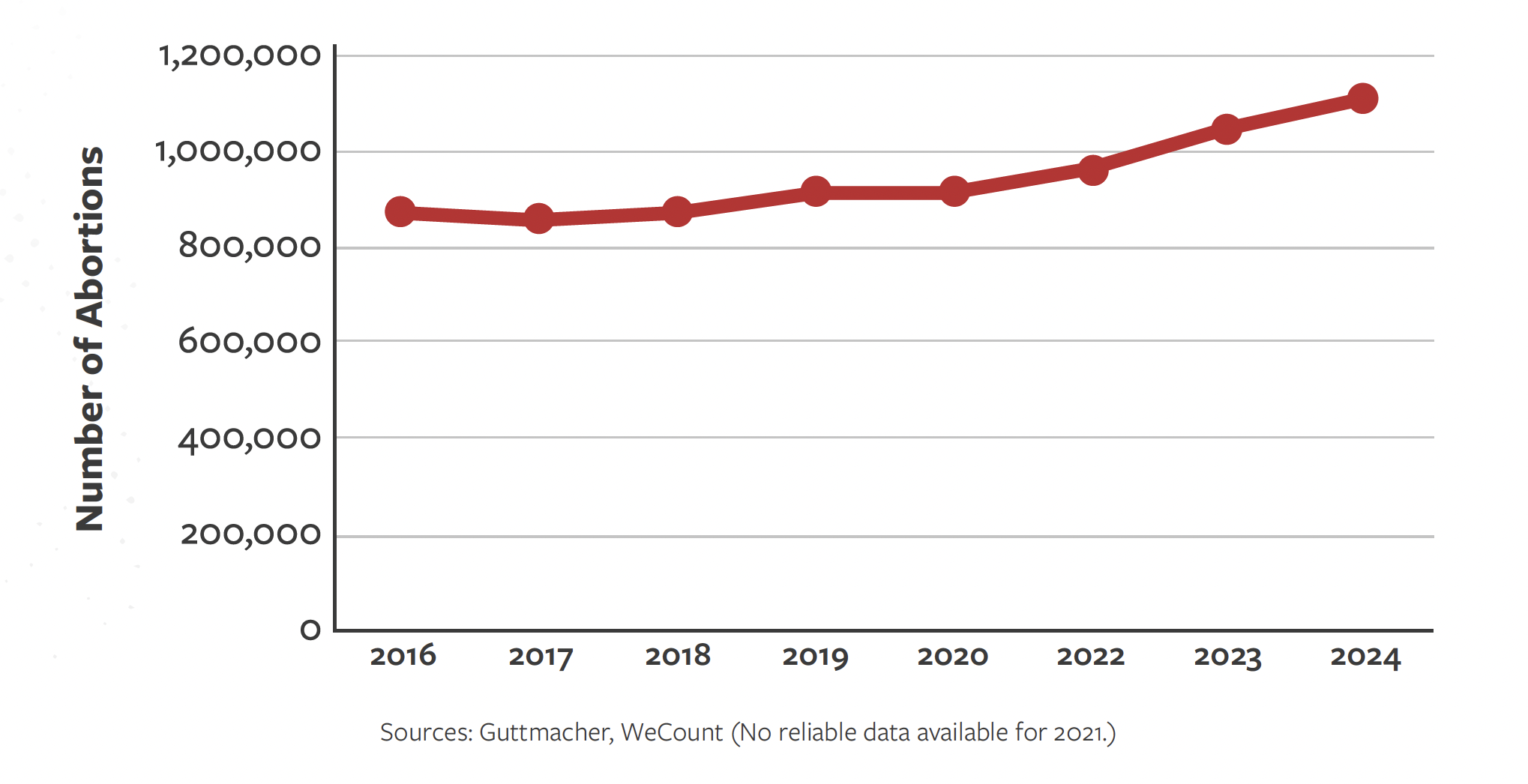
Abortion is increasing in the United States, with more than 1 million babies aborted in 2024.

The largest driver of the abortion increase since 2020 has been mail-order chemical abortion pills.

Mail-order abortion endangers women, undermines state laws, and kills unborn babies.

President Trump can and should act to end the Biden Administration’s
mail-order abortion scheme.
Background
The number of total abortions in the United States has increased rapidly since the COVID-19 pandemic, despite the U.S. Supreme Court decision that overturned Roe v. Wade. During the same period, the number of mail-order abortions has skyrocketed following the Biden Administration’s reckless decision to remove the in-person dispensing requirement for the chemical abortion drug mifepristone. Our analysis of abortion data collected from pro-abortion sources suggests that mail-order abortion is the primary driver of the increase in overall abortions.
A study by the Restoration of America Foundation (ROAF) done in April 2025 found that more than 1 in 10 women who use the chemical abortion pill experience a serious adverse event.1 Abortion-by-mail is increasing this risk by bypassing in-person clinical evaluations. This lack of medical oversight from a qualified physician puts women at risk for coercion2 and poisoning3 and increases emergency room visits4 and hospitalizations.5 Under the mail-order abortion scheme, states are powerless to enforce pro-life laws and protect their citizens. President Trump has the power to end the Biden-era mail-order abortion policy and bring back commonsense regulation to the abortion industry.
Abortion Is Increasing in the United States
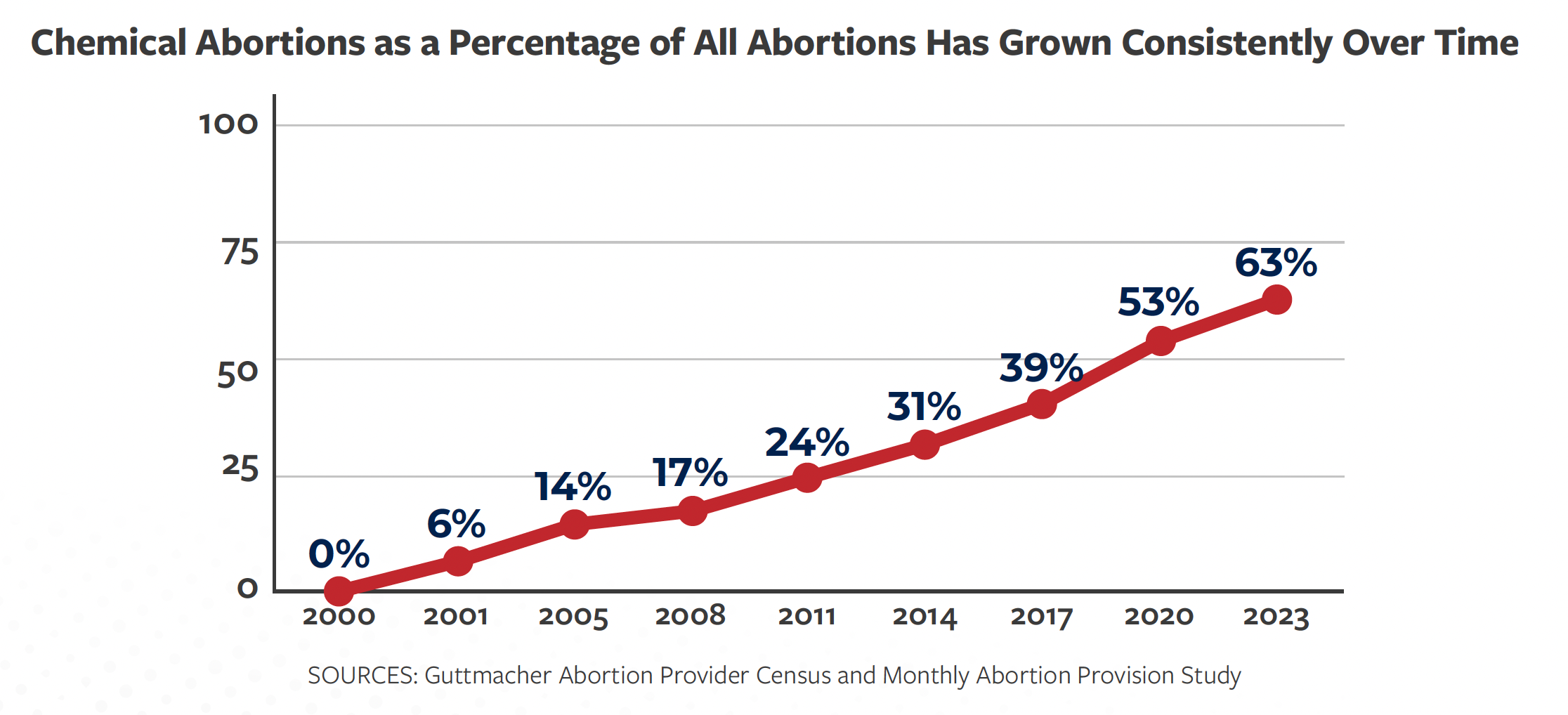
Chemical Abortion Is Increasingly Prevalent Alongside the Rise of Mail-Order Abortion
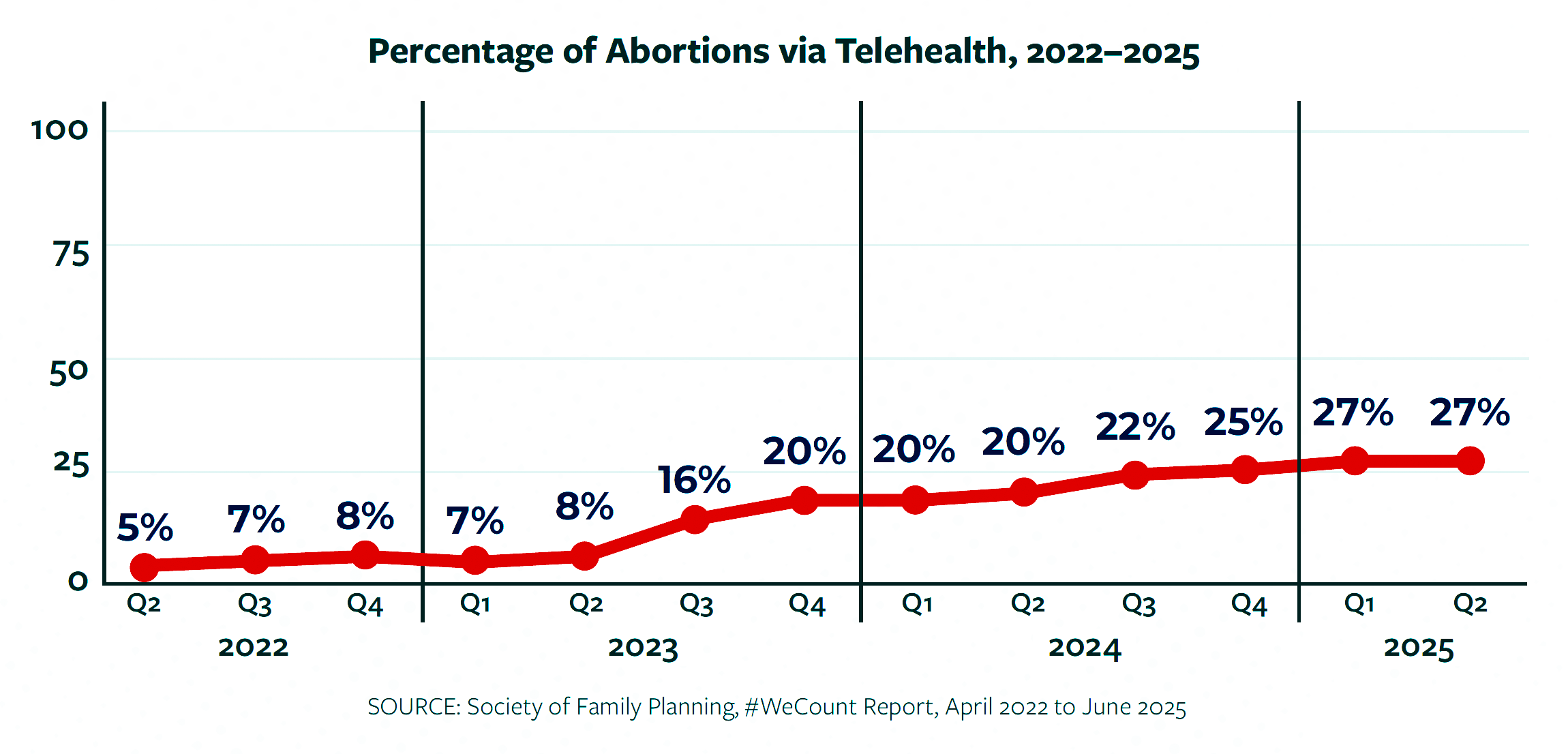
At the same time, the use of mail-order abortions has been rapidly increasing. Abortions obtained by telehealth (also referred to as mail-order abortions in this paper) accounted for roughly 27 percent of all abortions in the first half of 2025, up from 5 percent of abortions during April through June of 2022.14
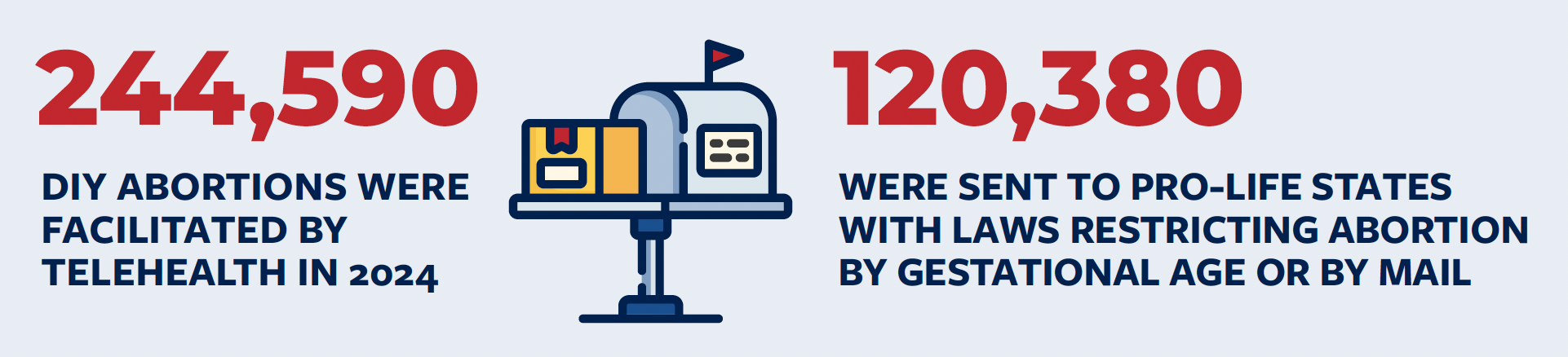
The Proliferation of DIY, Mail-Order Abortions Is the Likeliest Cause of America’s Rising Abortion Rate
The Biden Administration Removed Commonsense Safeguards to Legalize Mail-Order Abortion
President Trump Can and Should Dismantle the Biden Administration’s Mail-Order Abortion Scheme
REFERENCES
1ROA Foundation. (n.d.). Chemical abortion research.
https://www.roafoundation.org/chemical-abortion-research/
2The 19th. (2025, January 31). Minor abortion pills: Louisiana mother, New York doctor indicted.
https://19thnews.org/2025/01/minor-abortion-pills-louisiana-mother-new-york-doctor-indicted/
3NBC News. (2024, February 8). Texas attorney sentenced to 180 days in jail for poisoning pregnant wife with abortion pills.
https://www.nbcnews.com/news/us-news/texas-attorney-poisoned-pregnant-wife-abortion-medication-sentenced-18-rcna138065
4The Heritage Foundation. (2024, November 4). Evidence emergency room visits due to abortion complications have increased.
https://www.heritage.org/life/report/evidence-emergency-room-visits-due-abortion-complications-have-increased-the-fda
5Hyland, P., Raymond, E. G., & Chong, E. (2018). A direct-to-patient telemedicine abortion service in Australia: Retrospective analysis of the first 18 months.
Australian and New Zealand Journal of Obstetrics and Gynaecology, 58(3), 335–340. https://obgyn.onlinelibrary.wiley.com/doi/10.1111/ajo.12800 as compared to the FDA label for mifepristone: Food and Drug Administration. (2016). Mifeprex (mifepristone) tablets label.
https://www.accessdata.fda.gov/drugsatfda_docs/label/2016/020687s020lbl.pdf
6Hyland, P., Raymond, E. G., & Chong, E. (2018). A direct-to-patient telemedicine abortion service in Australia: Retrospective analysis of the first 18 months. Australian and New Zealand Journal of Obstetrics and Gynaecology, 58(3), 335–340. https://obgyn.onlinelibrary.wiley.com/doi/10.1111/ajo.12800 as compared to the FDA label for mifepristone: Food and Drug Administration. (2016). Mifeprex (mifepristone) tablets label.
https://www.accessdata.fda.gov/drugsatfda_docs/label/2016/020687s020lbl.pdf
7Guttmacher Institute. (n.d.). Induced abortion in the United States. https://www.guttmacher.org/fact-sheet/induced-abortion-united-states
8Guttmacher Institute. (2019). Abortion incidence and service availability in the United States, 2017.
https://www.guttmacher.org/report/abortion-incidence-service-availability-us-2017
9Guttmacher estimates that there were 1,038,000 abortions procured in 2024. However, current Guttmacher methodology notes that it undercounts abortions, including by excluding mail-order chemical abortion pills sent to states with total bans on abortion that originate in pro-abortion states with Shield laws. An estimate of abortions in that category is available from WeCount, which estimates a 76,140 were facilitated by Shield laws to total ban states in 2024.
10Society of Family Planning. (2025). #WeCount June 2025 data.
https://societyfp.org/research/wecount/wecount-june-2025-data/
11For an in-depth look at the history of the regulatory regimen surrounding chemical abortion until 2021, including the Food and Drug Administration’s approval process for mifepristone, we recommend the following source: Israel, M. (2021, January 28). Chemical abortion: A review. The Heritage Foundation. https://www.heritage.org/life/report/chemical-abortion-review
12Jones, R., & Friedrich-Karnik, A. (2024, March 12). Medication abortion accounted for 63% of all US abortions in 2023—an increase from 53% in 2020. Guttmacher Institute. https://www.guttmacher.org/2024/03/medication-abortion-accounted-63-all-us-abortions-2023-increase-53-2020
13Author’s calculations based on the number of total abortions in 2024 and a chemical abortion share of 63 percent.
14Society of Family Planning. (2025). #WeCount June 2025 data.
https://societyfp.org/research/wecount/wecount-june-2025-data/
15Guttmacher Institute. (2019). Abortion incidence and service availability in the United States, 2017.
https://www.guttmacher.org/report/abortion-incidence-service-availability-us-2017
16Author’s calculations.
17Federal Reserve Bank of St. Louis. (n.d.). Population [Data set].
https://fred.stlouisfed.org/series/POPTHM
18Society of Family Planning. (2025). #WeCount June 2025 data.
https://societyfp.org/research/wecount/wecount-june-2025-data/
19U.S. Government Accountability Office. (2018). Food and Drug Administration: Information on mifepristone for medical termination of pregnancy (GAO-18-292, p. 11). https://www.gao.gov/assets/gao-18-292.pdf#page=11
20American College of Obstetricians and Gynecologists. (2020). Letter to the FDA: Medication abortion [PDF].
https://www.acog.org/-/media/project/acog/acogorg/files/advocacy/pi-order-medication-abortion-71320.pdf
21Howe, A. (2021, January 12). Justices grant FDA request to block mail delivery of abortion pills. SCOTUSblog.
https://www.scotusblog.com/2021/01/justices-grant-fda-request-to-block-mail-delivery-of-abortion-pills/
22Ollstein, A. M., & Tahir, D. (2021, April 12). FDA lifts curbs on dispensing abortion pills during pandemic. Politico. https://www.politico.com/news/2021/04/12/abortion-pills-481092
23McCammon, S. (2021, December 16). Today is the FDA’s deadline to complete a review of its rules for abortion pill. NPR. https://www.npr.org/2021/12/16/1064951611/today-is-the-fda-s-deadline-to-complete-a-review-of-its-rules-for-abortion-pill
24Food and Drug Administration. (2026, January 17). Information about mifepristone for medical termination of pregnancy through ten weeks gestation.
https://www.fda.gov/drugs/postmarket-drug-safety-information-patients-and-providers/information-about-mifepristone-medical-termination-pregnancy-through-ten-weeks-gestation
25Food and Drug Administration. (2023). Summary review (Application No. 020687Orig1s025).
https://www.accessdata.fda.gov/drugsatfda_docs/summary_review/2023/020687Orig1s025SumR.pdf
26Food and Drug Administration. (2016). Medical review (Application No. 020687Orig1s020, p. 9). https://www.accessdata.fda.gov/drugsatfda_docs/nda/2016/020687Orig1s020MedR.pdf#page=9
27Cirucci, C. A., Aultman, K. A., & Harrison, D. J. (2021). Mifepristone adverse events identified by Planned Parenthood in 2009 and 2010 compared to those in the FDA adverse event reporting system and those obtained through the Freedom of Information Act. Health Services Research and Managerial Epidemiology, 8. https://pmc.ncbi.nlm.nih.gov/articles/PMC8724996/
28Alliance for Hippocratic Medicine v. U.S. Food and Drug Administration, No. 23-10362, p. 49 (5th Cir. 2023).
https://www.ca5.uscourts.gov/opinions/pub/23/23-10362-CV1.pdf#page=49
29Food and Drug Administration v. Alliance for Hippocratic Medicine, 602 U.S. ___ (2024).
https://www.supremecourt.gov/opinions/23pdf/23-235_n7ip.pdf
30LaRose, G. (2025, October 9). Louisiana sues Food & Drug Administration to stop mailing of abortion medication. Louisiana Illuminator.
https://lailluminator.com/2025/10/09/fda-abortion/
31Kobach, K. W. (2025, August 13). Letter to HHS and FDA regarding mifepristone. DocumentCloud.
https://www.documentcloud.org/documents/26157662-mifepristoneletter081325/
32Democracy Forward. (2025, September 19). Letter to FDA and HHS [PDF].
https://democracyforward.org/wp-content/uploads/2025/09/Fda_Hhs_Letter-1.pdf
33Graham, L., et al. (2025, October 9). [Letter to HHS and FDA regarding mifepristone]. U.S. Senate.
https://www.lgraham.senate.gov/public/_cache/files/db3c8d4f-f16b-4393-9005-13461dcde9c2/letter-from-senator-graham-et-al-to-hhs-and-fda-re-mifepristone.pdf
34The Daily Wire. (n.d.). Reverse this wrong: Republicans push RFK to fix Biden’s abortion drug mistakes.
https://www.dailywire.com/news/reverse-this-wrong-republicans-push-rfk-to-fix-bidens-abortion-drug-mistakes