
Mail-Order Abortion Pills Are Flooding Pro-Life States. Trump Can Stop It.
225 women are harmed by the abortion pill every day.
Mail-Order Abortion Pills Are Flooding Pro-Life States. Trump Can Stop It.
Key Points
Pills crossing state lines
Out-of-state abortionists send dangerous chemical abortion pills into pro-life states at scale, protected by blue state "shield laws" and lax federal regulations.
~15,000 pills per month
Nearly 15,000 chemical abortion pills are mailed monthly into states with pro-life laws — and that number has grown consistently since tracking began in 2023.
Abortions rising post-Dobbs
Despite Roe v. Wade being overturned, nine states with pro-life laws had more monthly abortions in 2025 than they did in 2022, before the court decision.
328,000+ shield law abortions
As of December 2025, more than 328,000 abortions have been performed across state lines under shield law protections, emboldening abortionists hundreds of miles away.
The Trump Administration can act immediately. Shield law abortions undermine good medical practice, threaten constitutional federalism, and endanger women.
Introduction
Overturning Roe v. Wade was a pro-life achievement nearly 50 years in the making, reversing a disastrous, unconstitutional policy that forced anti-life law onto the entire country and resulted in the deaths of more than 63 million unborn lives.1 In June of 2022, the Supreme Court ruled in Dobbs v. Jackson that states could once again enact laws to protect life in the womb, and states responded swiftly. By the end of 2022, 11 states had successfully passed laws that protected all unborn life, and two additional states had laws in effect protecting life from the first detectable heartbeat.2 While there have been intense battles about abortion in many states across the country, it’s undeniable that overturning Roe created a real opportunity for the pro-life movement to legally protect life.
However, pro-abortion states have acted as well, not just to expand abortion within their own state borders, but also to pass abortion “shield laws” that embolden abortionists within their borders to undermine the pro-life laws of other states. The strategy of using shield laws to push abortion in states where it is illegal has been incredibly successful. In red states like Texas, Louisiana, and Alabama, with some of the strongest pro-life laws in the country, more abortions occurred monthly in 2025 than before Roe was overturned. Data from pro-abortion sources shows that abortionists from blue states like Massachusetts, New York, and California are successfully flooding pro-life states with nearly 15,000 chemical abortion pills per month.3 In 2025, #WeCount identified 169,000 abortions provided under shield laws to states with restrictive laws.4

Despite their best efforts, pro-life states have struggled to stem the flow of illegal pills across their borders. Federal officials already have multiple tools at their disposal to stop this, and they should act swiftly.
Our analysis of the Society of Family Planning’s data project #WeCount’s latest data release shows that chemical abortion pills from out-of-state abortionists are being shipped into every pro-life state through the formal medical system, and the total number of these abortions has grown rapidly since they began tracking the practice in July of 2023.5 Since #WeCount began collecting this data, monthly provisions of chemical abortion pills into pro-life states have grown consistently, from 5,400 pills sent in July of 2023 to 14,870 in December of 2025.6 In total, more than 328,000 abortion pills have been sent into pro-life states from out-of-state abortionists as of December 2025.7

Every pro-life state is facing a barrage of pills, regardless of geography or the strength of the state’s laws. Currently, 13 states have a total ban on elective abortion,8 five states have so-called “heartbeat laws” that limit elective abortion to six-week gestational age,9 and six states have telehealth restrictions.10 In each of these states, out-of-state mail-order abortions have constituted a rising number of abortions.11 In every state with total protection for unborn human life, monthly mail-order abortions have grown since the practice first began at scale in July of 2023,12 and these shield-law-facilitated abortions now constitute all or nearly all abortions in the state.13 Following implementation of their pro-life laws, all 11 states with a total ban on abortion by the end of 2022 had zero abortions occurring inside the formal healthcare system in April of 2023.14 That trend has now been completely reversed, with all pro-life states having significant numbers of abortions occurring in their states provided by out-of-state abortionists.15 In fact, in nine pro-life states, monthly abortions were higher in December of 2025 than they were before Roe was overturned: Alabama, Arkansas, Florida, Kentucky, Louisiana, Mississippi, South Carolina, South Dakota, and Texas.16
While women from pro-life states may have chosen to travel to another state for an abortion or receive an illegal pill from an overseas vendor, the data shows that pro-life laws were working. One study found that Texas’s pro-life laws saved nearly 10,000 babies in just the last nine months of 2022.17 A paper analyzing fertility data from the first half of 2023 likewise found that pro-life laws increased births by 2.3 percent, resulting in up to 32,000 more babies born than otherwise would have been.18 States like Mississippi and Texas had even larger increases in babies saved by pro-life laws because their geography discourages interstate travel for abortion.19 The data now shows that mail-order abortion is overwhelming the ability of states to protect unborn life, undoing these crucial wins.
State Spotlight—Texas
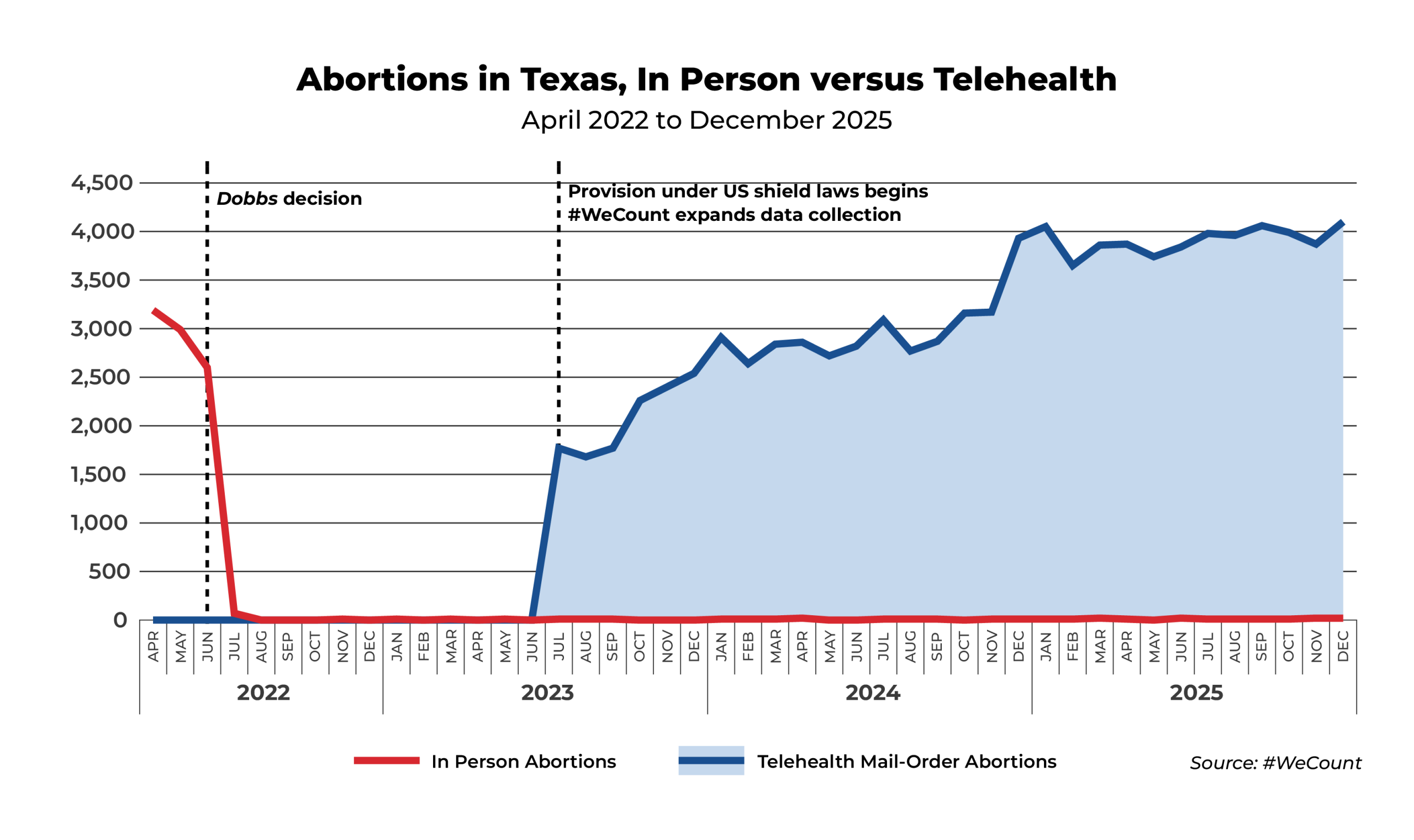
However, analysis of the #WeCount data shows that mail-order abortion has reversed this incredible pro-life progress. In December of 2025, the most recent month of data analyzed, Texas had 29 percent more abortions than it did in April of 2022, before Roe v. Wade was overturned.22 The most recent monthly number, December of 2025, consisted of more than 4,000 mail-order abortions, illegal under state law but federally permitted.23 The monthly average of out-of-state abortions in 2025 has nearly doubled since the latter half of 2023, when out-of-state abortion providers began shipping pills into Texas at scale.24 In 2025, Texas had more than 46,000 illegal abortions sent from out-of-state providers, making up nearly 100 percent of all abortions that #WeCount identified in the state.25
Abortionists are exploiting lax federal regulations and pro-abortion state laws to ship abortion pills into pro-life states at scale.
Shield laws are designed to prevent a state with legal restrictions or bans on abortion from bringing legal action against abortionists and people obtaining an abortion in a state where abortion is legal. Components of shield laws can include prohibiting state agencies or officials from participating in out-of-state investigations into abortions and refusing to enforce civil judgments from out-of-state courts related to the provision of an abortion. State shield laws can apply when the abortionist prescribes a pill to an out-of-state patient in direct violation of the patient’s state laws and in violation of medical location of care norms. Some states explicitly spell out protection of cross-state telehealth abortion care in their shield laws. Connecticut was the first state to enact a shield law in May of 2022 in anticipation of the Dobbs decision.28 In 2022, Massachusetts enacted a “telehealth” shield law that protected doctors providing chemical abortion across state lines,29 and other Democrat-controlled states followed suit in 2023, specifically to extend the reach of chemical abortion into pro-life states.30
In the summer of 2023, online abortion provider Aid Access announced that it would begin using American-based, state-licensed medical professionals to send abortion pills to all 50 states. Aid Access has been sending abortion pills into the United States from overseas in violation of federal law31 since 2018. The organization exploited the deregulation of the abortion pill under President Biden that allowed for mail-order chemical abortion, paired with blue state laws that protected abortionists from out-of-state criminal judgments, to allow the organization to expand its reach while technically operating within the formal medical system. Other organizations, including the Abortion Coalition for Telemedicine (ACT) and the Massachusetts Medication Abortion Access Project (the MAP), soon followed. In July of that year, the #WeCount project began tracking how many abortions were occurring under this framework. Virtual chemical abortion providers allow residents in any state, regardless of the law in the patient’s state, to request an abortion pill and receive it by mail, often by simply filling out an online form. For around $150 per pill (prices vary), anyone can request and receive an abortion pill, no pregnancy verification necessary.
Currently, 22 states and Washington D.C. have some form of shield law that covers abortion.32 Eight states provide explicit protection for providers engaged in virtual-only abortion care to patients in states with abortion restrictions33—including California, Massachusetts, New York, and Washington, which are frequently cited in news stories as hubs for the dispensing of mail-order abortion pills to pro-life states. While some also cover so-called “gender-affirming care” — a euphemism for chemical and surgical gender mutilation—they are otherwise limited in scope, not protecting, for example, a physician interested in providing care to patients with back pain across state lines. As is often the case with abortion, which is a violation of the core principles of medicine as a restorative and life-defending practice, pro-abortion advocates and policymakers carve out special rules for this gruesome practice.
There is no publicly available data on exactly how many abortion pills come from each shield law state, nor where each provider operating through virtual-only abortion clinics is located. The only certainty is that virtually-provided abortion pills in the dataset used for this paper originate in states with these laws.
For the pro-abortion movement and the businesses involved, this effort has been a huge success. These virtual providers serve every state, regardless of the abortion laws of the patient state, and in 2025, sent a total of 294,180 pills through the virtual-only mail-order abortion business model.34 More than half of those pills were sent into states with abortion restrictions.35 Mail-order abortions now represent more than a quarter of all abortions in the United States,36 and the number of them has been growing rapidly.37

The out-of-state abortion scheme threatens our constitutional system and undermines the practice of medicine.
In addition to saving many babies conceived in pro-life states, pro-life laws protect the integrity of the medical profession and provide an important guide to citizens about the value of human life. In contrast, shield laws and the abortionists who practice under them undermine the practice of medicine and threaten the foundation of the United States—our constitutional system of government.
Shield laws undermine the integrity of the medical profession by allowing high-risk behavior from abortionists that is not tolerated for other medical practitioners. Typically, medical providers are discouraged from providing care to patients in states where they do not hold a medical license. In an oft-cited legal paper setting out the framework for shield laws, “The New Abortion Battleground,” the writers admit, “Changing the default location of care would have significant consequences for the entire healthcare ecosystem, and as a result, current proposals are limited to abortion care…”38 Additionally, states like California, New York, Washington, and Colorado have passed laws permitting abortionists to keep their names off of abortion medication prescriptions,39 meaning that women harmed by malpractice may not even be able to identify the abortionist to blame. A Restoration News investigation found that several prominent online chemical abortion providers openly flout the Food and Drug Administration’s (FDA) regulations on prescribing mifepristone, including by prescribing the pill beyond the 70-day gestational age limit.40 An investigation launched by U.S. Senator Bill Cassidy (R-LA) and several of his colleagues also raised concerns about telehealth abortionists failing to comply with FDA regulations on mifepristone.41
Additionally, shield laws raise constitutional questions that have yet to be answered, and, at the very least, destabilize the fabric of the U.S. system of government by increasing interstate conflict. In the same article from The Columbia Law Review on shield laws, the writers address that the shield law framework threatens the very basis of federalism:
Even if the suggestions included in this section are on constitutionally firm ground, there is no denying that each of these proposals would threaten basic principles of comity between states, possibly resulting in the breakdown of state-to-state relations and ultimately retaliation…The shield provisions discussed here would go a long way toward protecting a state’s providers and increasing access for out-of-state patients seeking out those providers, but they would also intensify interstate conflict in a way that could have unintended consequences for other areas of law as well as for the general fabric of the country’s federalist form of government.42
It is unclear if shield laws are on firm constitutional ground—the federal court system has yet to weigh in, though lawsuits are already pending43—but at the very least, such laws undermine the important American tradition of interstate comity, or general respect among states for each other’s laws. As Senior Legal Fellow Thomas Jipping writes for The Heritage Foundation in his analysis of shield laws, “[i]nterstate comity of the kind described here is, by itself, a critical feature of the kind of polity, a union of sovereign states, that America’s Founders established… sacrificing comity and moving toward normalizing interstate conflict and retaliation is a choice, and one that will likely have long-term negative consequences far beyond the abortion context.”44 While a full analysis of the constitutional issues with shield laws is beyond the scope of this paper, an in-depth discussion of constitutional issues with shield laws can be found in the aforementioned Heritage Foundation paper.
When federal policy choices allow for pro-abortion states and the abortionists who practice there to undermine pro-life state laws at scale, it does more than endanger the lives of babies and their mothers—it demeans the practice of medicine and threatens the very fabric of the country.
While pro-life states are trying novel approaches, the Trump Administration already has the tools to solve this.
States have tried to defend their citizens from the unaccountable abortionists, sometimes thousands of miles away, but no state has been able to successfully enforce legal action against out-of-state abortionists violating their laws. UCLA’s Center on Reproductive Health, Law, and Policy has tracked the challenges to shield laws from pro-life states trying to protect their citizens from rogue abortionists.45 So far, Texas and Louisiana have attempted to bring legal action against out-of-state bad actors without success.46 Louisiana’s attempts to extradite abortionists from California and New York have been denied by Governors Gavin Newsom and Kathy Hochul respectively.47 Texas was unsuccessful in enforcing a civil suit against New York abortionist Dr. Maggie Carpenter, with the New York state court ruling that a state employee’s refusal to process Texas’s enforcement request was in line with its shield law.48 In September of 2025, Texas Governor Greg Abbott signed a new law (House Bill 7) to allow any private Texas citizen to bring a civil suit against anyone involved in the manufacturing, distribution, mailing, transporting, prescribing, or providing abortion drugs to anyone in the state—empowering citizens to sue out-of-state providers.49 In the words of the sponsor of the bill, State Rep. Jeff Leach, the goal of the bill is “to stop those who are selling, distributing, and aiding the trafficking of these illegal abortion pills in Texas.”50 A lawsuit filed under this legislation against a Delaware telehealth abortionist is still pending.51 A Louisiana lawsuit against the FDA challenging the legality of the regulations that permit mail-order abortion at the federal level is likewise pending.52
However, while the success of state attempts in escalating court cases is uncertain, Trump Administration officials can act now to prevent online providers from sending dangerous abortion pills into every state. First, the FDA can act immediately to reverse the Biden-era Risk Evaluation and Mitigation Strategy (REMS) revision on the chemical abortion drug mifepristone that allowed for the pill to be prescribed by telehealth and sent by mail. At the same time, the Department of Justice can act to rescind the Biden-era memorandum on the Comstock Act and enforce existing federal law that prevents the use of any mail carrier or online service to transport chemical abortion drugs, including by taking swift legal action against the largest abortion pill mills if they refuse to cease interstate shipping. Lastly, the FDA can and should take immediate action to stop the violation of current regulations that is widespread among these unaccountable online abortion providers. Senator Cassidy, a doctor and the Chairman of the Senate Health, Education, Labor, and Pensions Committee, recently sent a letter to the FDA urging them to use their regulatory power to shut down online retailers marketing and selling the chemical abortion drug regimen in violation of federal law and regulations.53 Administration officials can take these issues concurrently to shut down the dangerous virtual mail-order abortion business.
Conclusion
In a statement on Truth Social in April 2024, President Trump said, “This 50 year battle over Roe v. Wade took it out of the federal hands and brought it into the hearts, minds and vote of the people in each state. It was really something. Now it’s up to the states to do the right thing.” The reality on the ground is much different—no matter what state voters decide and how dedicated their leaders are to enforcing their laws, pro-life states have been unable to stem the flood of dangerous chemical abortion pills into their states. This is not simply a side effect of other states’ pro-abortion policies—on the contrary, it was the explicit motivation of the construction of certain shield laws and their implementation in states like New York, Massachusetts, and Washington.54 If pro-life states have no power to protect their women and babies from rogue abortionists thousands of miles away, the situation they find themselves in is not better than before the Dobbs decision—it’s worse. For the sake of our constitutional order, to say nothing of the women and babies in peril, Trump Administration officials must act swiftly and decisively to end interstate mail-order abortion.
Appendix – Abortions in Pro-Life States
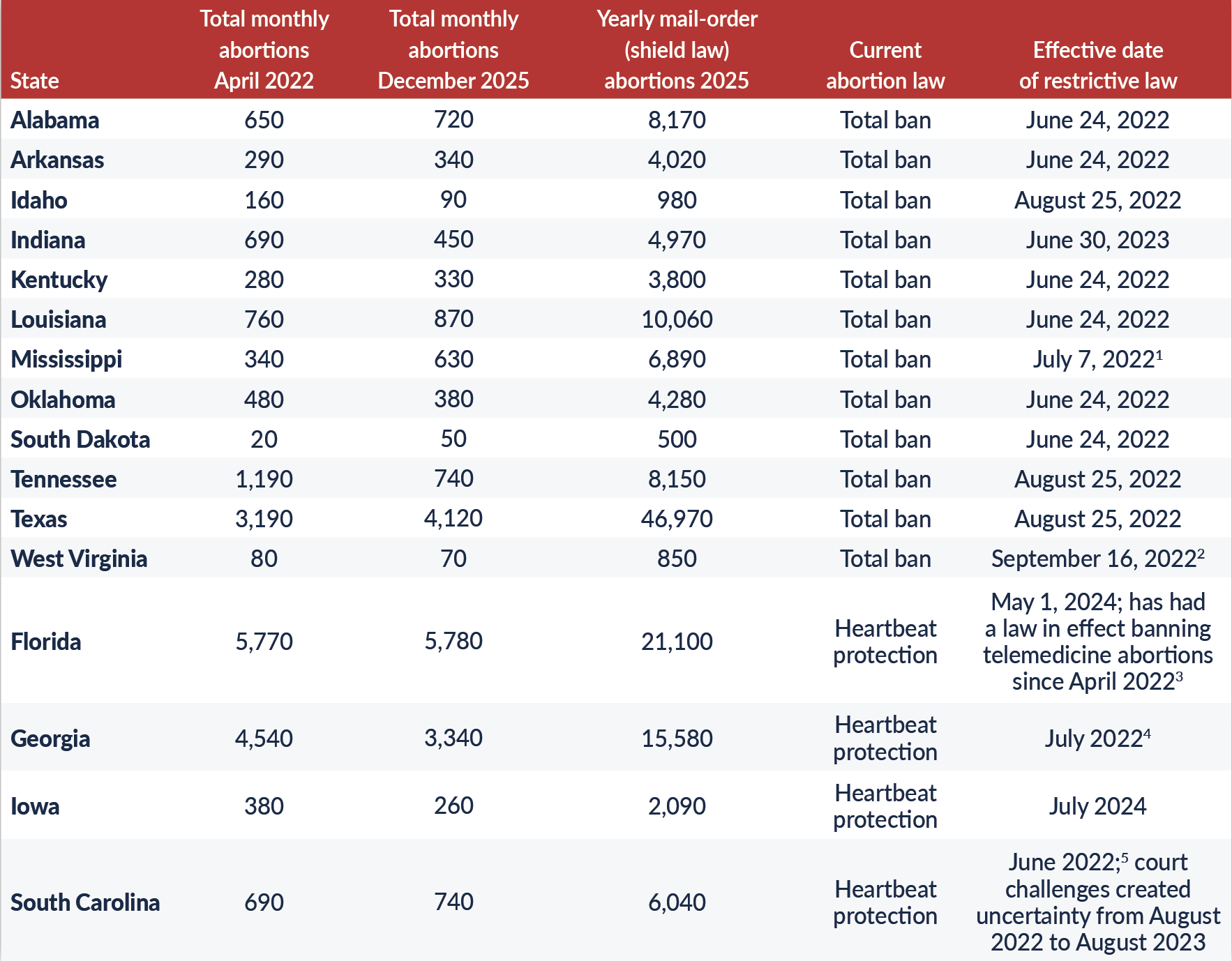
Source for state laws, unless otherwise noted Center for Reproductive Rights.6
Note: North Dakota has a current total ban on abortion (effective November 2025),7 and Wyoming has a heartbeat protection law (effective March 2026).8 Because the enactment of these laws fell outside of the timeframe in the #WeCount dataset, we do not analyze them for this paper.
Note: The #WeCount Project began tracking abortions in April of 2022, just a couple months before Dobbs was overturned in June of the same year. #WeCount began tracking pills provided under shield laws for the month of July 2023.
1. Ashton Pittman, “Mississippi AG Certifies Trigger Law, Criminalizing Most Abortions by July 7,” Mississippi Free Press, June 27, 2022,
https://www.mississippifreepress.org/mississippi-ag-certifies-trigger-law-criminalizing-most-abortions-by-july-7/.
2. Associated Press, “West Virginia Gov. Jim Justice Signs Abortion Ban into Law,” Politico, September 16, 2022,
https://www.politico.com/news/2022/09/16/west-virginia-jim-justice-abortion-ban-law-00057255.
3. Ian Hodgson, “Can Florida Enforce Its Law That Restricts Telehealth Abortions?,” Governing, July 1, 2022,
https://www.governing.com/now/can-florida-enforce-its-law-that-restricts-telehealth-abortions.
4. Associated Press, “Georgia’s Highest Court Reinstates Ban on Abortions After 6 Weeks,” NPR, November 23, 2022,
https://www.npr.org/2022/11/23/1139039767/georgia-supreme-court-reinstates-abortion-ban.
5. Alice V. Harris, “South Carolina Supreme Court Holds ‘Fetal Heartbeat Law’ Is Unconstitutional: Abortion Laws Remain the Same as Before the United States Supreme Court’s Decision in Dobbs,” Maynard Nexsen, January 6, 2023, https://www.maynardnexsen.com/publication-south-carolina-supreme-court-holds-fetal-heartbeat-law-is-unconstitutional-abortion-laws-remain-the-same-as-before.
6. “After Roe Fell: U.S. Abortion Laws by State,” Center for Reproductive Rights, accessed May 8, 2026, https://reproductiverights.org/maps/abortion-laws-by-state/.
7. “North Dakota,” Center for Reproductive Rights, accessed May 8, 2026, https://reproductiverights.org/maps/abortion-laws-by-state/north-dakota/.
8. “Wyoming,” Center for Reproductive Rights, accessed May 8, 2026, https://reproductiverights.org/maps/abortion-laws-by-state/wyoming/.
References
- National Right to Life Committee, “Abortion Statistics: United States Data and Trends,” January 2022, nrlc.org.
- See appendix table.
- Society of Family Planning, “#WeCount Report, April 2022 through December 2025,” June 10, 2026, societyfp.org.
- Author’s calculations based on data tables from Society of Family Planning, “#WeCount Report, April 2022 through December 2025,” June 10, 2026, societyfp.org.
- Society of Family Planning, “#WeCount Report, April 2022 through December 2025.”
- Author’s calculations based on data tables from Society of Family Planning, “#WeCount Report, April 2022 through December 2025.”
- Author’s calculations based on data tables from Society of Family Planning, “#WeCount Report, April 2022 through December 2025.”
- See appendix table for specific states and implementation dates.
- See appendix table for specific states and implementation dates.
- During the timeframe of the data covered in this paper, state laws have fluctuated, particularly with regards to telehealth restrictions, and it’s not always clear which states #WeCount included in their count each month. In the #WeCount Report Narrative on the most recent data, the following states are identified as having telehealth restrictions: Arizona, Alaska, Missouri, Nebraska, North Carolina, Utah, Wisconsin, and Wyoming. Society of Family Planning, “#WeCount Report, April 2022 to December 2025,” June 10, 2026, https://societyfp.org/wp-content/uploads/2026/05/WeCount-Report-11-Dec-2025-data.pdf, page 11. #WeCount’s methodology says it relied on the RHITES Map for tracking state restrictions on telehealth abortion, which currently highlights some telehealth restrictions in the following states without total or six-week bans on abortion: Alaska, Nebraska, North Carolina, Missouri, Utah, and Wisconsin. “State of Telehealth Medication Abortion,” Reproductive Health Initiative for Telehealth Equity & Solutions, accessed June 22, 2026, https://www.rhites.org/maps.
- Society of Family Planning, “#WeCount Report, April 2022 through December 2025: Summary Slides,” June 10, 2026, societyfp.org.
- Author’s calculations based on data tables from Society of Family Planning, “#WeCount Report, April 2022 through December 2025.”
- Society of Family Planning, “#WeCount Report, April 2022 through December 2025.”
- Society of Family Planning, “#WeCount Report, April 2022 through December 2025: Data Tables.”
- See appendix table.
- Society of Family Planning, “#WeCount Report, April 2022 through December 2025: Data Tables.”
- Jonathan Abbamonte and Melanie Israel, “Texas Heartbeat Act Has Saved Nearly 10,000 Babies from Abortion, New Study Estimates,” The Heritage Foundation, July 19, 2023, heritage.org.
- Daniel Dench et al., “The Effects of Post-Dobbs Abortion Bans on Fertility,” Journal of Public Economics 234 (2024): 105124, doi.org.
- Dench et al., “Post-Dobbs Abortion Bans.”
- “History of Abortion Laws,” Texas State Law Library, last modified February 11, 2026, guides.sll.texas.gov.
- Abbamonte and Israel, “Texas Heartbeat Act.”
- Author’s calculations based on data tables from Society of Family Planning, “#WeCount Report, April 2022 through December 2025.”
- Author’s calculations based on data tables from Society of Family Planning, “#WeCount Report, April 2022 through December 2025.”
- Author’s calculations based on data tables from Society of Family Planning, “#WeCount Report, April 2022 through December 2025.”
- Author’s calculations based on data tables from Society of Family Planning, “#WeCount Report, April 2022 through December 2025.”
- Sarah McCammon, “FDA Relaxes Restrictions on Abortion Pill,” NPR, December 16, 2021, npr.org.
- Pam Belluck and Emily Bazelon, “New York Passes Bill to Shield Abortion Providers Sending Pills into States with Bans,” New York Times, June 20, 2023, nytimes.com.
- “Reproductive Rights,” Office of the Attorney General William Tong, accessed May 8, 2026, portal.ct.gov.
- David S. Cohen et al., “The New Abortion Battleground,” Columbia Law Review 123, no. 1 (January 2023): 50, columbialawreview.org.
- Belluck and Bazelon, “New York Passes Bill to Shield Abortion Providers.”
- U.S. Food and Drug Administration to Aidaccess.org, warning letter, “Causing the Introduction of a Misbranded and Unapproved New Drug into Interstate Commerce,” March 8, 2019, fda.gov.
- “Shield Laws for Reproductive and Gender-Affirming Health Care: A State Law Guide,” UCLA School of Law, Center on Reproductive Health, Law, and Policy, last modified March 2026, law.ucla.edu.
- “Shield Laws for Reproductive and Gender-Affirming Health Care.”
- Author’s calculations based on data tables from Society of Family Planning, “#WeCount Report, April 2022 through December 2025.”
- #WeCount includes pills sent to states with restrictions on mail-order abortions, gestational limits at six weeks, and total bans on elective abortion. See Society of Family Planning, “#WeCount Report, April 2022 through December 2025.”
- Society of Family Planning, “#WeCount Report, April 2022 through December 2025.”
- Society of Family Planning, “#WeCount Report, April 2022 through December 2025.”
- Cohen et al., “New Abortion Battleground,” 50.
- Soumya Karlamangla, “Three Years After Dobbs, ‘the Reality Is People Are Getting Abortions,'” New York Times, December 9, 2025, nytimes.com.
- Hayden Ludwig and Samantha Flom, “The Abortion Pill Industrial Complex Flooding America with Illegal Drugs,” Restoration News, January 27, 2026, restoration-news.com.
- Bill Cassidy et al. to Martin A. Makary, letter, “Unapproved and Misbranded Mifepristone,” March 25, 2026, U.S. Senate Committee on Health, Education, Labor, and Pensions, help.senate.gov.
- Cohen et al., “New Abortion Battleground,” 52.
- “Shield Law Challenges,” UCLA School of Law, Center on Reproductive Health, Law, and Policy, last modified March 2026, law.ucla.edu.
- Thomas Jipping, “Abortion ‘Shield’ Laws Undermine Interstate Comity and Medical Practice and Raise Constitutional Questions,” The Heritage Foundation, December 30, 2024, heritage.org.
- “Shield Law Challenges.”
- “Shield Law Challenges.”
- “Shield Law Challenges.”
- “Shield Law Challenges.”
- “History of Abortion Laws.”
- Brandon Waltens, “Texas House Moves to Shut Down Mail-Order Abortion Pill Pipeline,” Texas Scorecard, August 28, 2025, texasscorecard.com.
- “Shield Law Challenges.”
- Daniel Wiessner, “US Judge Pauses Louisiana’s Challenge to FDA Abortion Drug Rule,” Reuters, April 7, 2026, reuters.com.
- Cassidy et al. to Makary, March 25, 2026.
- Belluck and Bazelon, “New York Passes Bill to Shield Abortion Providers.”